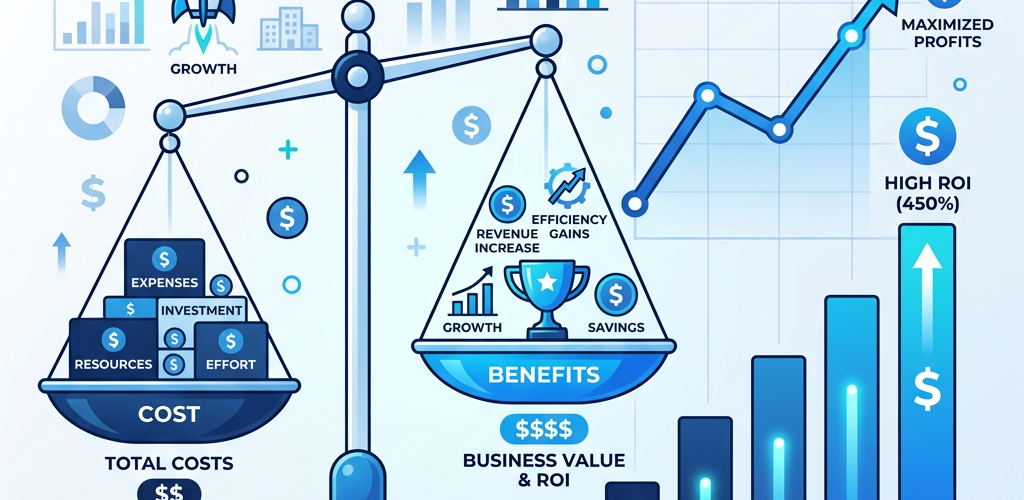
Let’s talk money. AI analytics tools cost $50-$500+ per month for small businesses. That’s real budget. So the question every business owner asks: is AI business intelligence actually worth what it costs, or is this just another overhyped tech trend?
Here’s the data-backed answer: for most small businesses doing more than $500K in annual revenue, AI analytics pays for itself in 2-6 weeks. Below that threshold, the ROI depends heavily on how you use it. Let me show you the math.
The Real Cost of NOT Having Analytics
Before we talk about AI analytics costs, let’s calculate what you’re already paying by operating without it:
Time spent on manual reporting: The average small business spends 8-12 hours per week on reporting and data analysis — pulling numbers from different tools, building spreadsheets, creating charts. At $50/hour (blended rate for owner/manager time), that’s $20,800-$31,200 per year in labor costs.
Missed opportunities: How many times have you discovered a trend or problem weeks after it started? A customer churn spike you didn’t catch until it was too late? A marketing channel that stopped working but you kept spending? Conservative estimate: 2-5% of revenue lost annually to delayed insights. For a $1M revenue business, that’s $20,000-$50,000.
Bad decisions from incomplete data: When you can’t see the full picture because data is scattered, you make decisions based on gut feel instead of data. Studies show data-driven businesses are 5-6% more productive (MIT, 2023). For a 10-person team at $60K average salary, that’s $30,000-$36,000 in productivity gains.
Total invisible cost: $70,800-$117,200 per year for a typical $1M revenue small business operating without analytics.
The Actual Cost of AI Analytics
Now let’s look at what AI analytics actually costs:
Pulse AI: Starts at accessible pricing for small businesses with a free trial. Typical SMB plan: $200-$400/month = $2,400-$4,800/year.
Power BI (with AI features): $20/user/month for Premium. For a 5-person team: $1,200/year. Note: requires setup time and technical skill.
ThoughtSpot: Enterprise pricing, typically $50,000+/year. Not practical for most small businesses.
Metabase (self-hosted): Free, but requires technical expertise to maintain and limited AI features.
For most small businesses, a realistic all-in cost is $2,400-$6,000 per year for a fully managed AI analytics solution.
The ROI Calculation
Let’s do the math for a typical scenario: a $1M annual revenue business with 8 employees.
Cost of AI analytics: $3,600/year (Pulse AI mid-tier plan)
Savings from reduced manual reporting: 8 hours/week × 52 weeks × $50/hour × 80% reduction = $16,640/year. You’ll still spend some time reviewing insights, but the manual data pulling and chart building is eliminated.
Revenue gains from faster decision-making: Even a conservative 1% revenue increase from catching opportunities and problems faster = $10,000/year additional revenue.
Cost savings from better resource allocation: Stop spending on underperforming marketing channels, optimize inventory, reduce customer churn. Conservative estimate: $5,000-$15,000/year.
Total annual benefit: $31,640-$41,640
Net ROI: $28,040-$38,040 annual gain
Payback period: 4-6 weeks
That’s an 880-1,156% ROI in year one. And the benefits compound over time as you build more historical data and deeper insights.
When AI Analytics ISN’T Worth It
Let’s be honest about scenarios where AI analytics doesn’t make sense:
You’re pre-revenue or doing less than $200K annually: You need to focus on product-market fit and customer acquisition first. Basic analytics (Google Analytics, simple dashboards) are sufficient until you’re at scale.
Your data is extremely messy or inconsistent: AI analytics amplifies data quality. If your data is garbage, the insights will be too. Clean your data foundation first.
Nobody on your team will use it: Analytics tools only create value if people actually use them. If your team won’t change behavior based on data, don’t invest yet. Build a data-driven culture first.
You’re in a business with very simple economics: If your entire business is “buy X for $Y, sell for $Z” with no variables, you might not need sophisticated analytics. A spreadsheet might suffice.
Hidden Costs to Watch Out For
When evaluating AI analytics platforms, watch for these potential cost traps:
Per-user pricing that scales expensively: Some tools charge per user. If your whole team needs access, this can add up fast. Look for plans with unlimited viewers or tiered user pricing.
Integration costs: Enterprise BI tools often require paid connectors for each data source. Verify integration costs before committing.
Data warehouse requirements: Some analytics platforms require you to set up and pay for a separate data warehouse (Snowflake, BigQuery). This can add $500-$5,000+/month in infrastructure costs. SMB-focused tools like Pulse AI handle this internally.
Consulting/setup fees: Traditional BI implementations often require expensive consultants to set up. Modern AI analytics should not require this.
The Compounding Value Over Time
The ROI calculation above is for year one. But the value of AI analytics compounds:
Year 1: You get the immediate time savings and basic insights. ROI: 800-1,100%.
Year 2: With a full year of historical data, the AI can identify seasonal patterns, year-over-year trends, and predictive insights. Your decision quality improves. ROI: 1,000-1,500%.
Year 3+: The AI knows your business deeply. It catches subtle anomalies, predicts problems before they happen, and becomes an irreplaceable part of your decision-making infrastructure. ROI: Incalculable — at this point, running your business without it would feel like flying blind.
How to Maximize Your AI Analytics ROI
If you decide to invest, here’s how to ensure you get the full value:
Week 1-2: Connect everything. Don’t just connect your revenue source. Connect ALL your business tools — marketing, finance, operations, CRM. The cross-source insights are where the magic happens.
Week 3-4: Replace your manual reports. Identify the 3-5 reports you currently build manually every week or month. Automate them in your AI analytics tool. Measure the time saved.
Month 2: Train your team to ask questions. The ROI multiplies when your whole team uses the tool. Run a training session: “Instead of asking me for data, ask the AI first.”
Month 3+: Act on insights. Analytics only creates value when you take action. Set up weekly review sessions: “What did the AI tell us this week, and what are we doing about it?”
Real-World Examples
E-commerce store, $2M revenue: Implemented Pulse AI for $300/month. Discovered that customers who bought Product A had a 60% higher lifetime value than average. Shifted marketing spend to focus on Product A buyers. Result: 18% increase in customer lifetime value, $180K additional revenue in 6 months. ROI: 10,000% in 6 months.
SaaS company, $500K ARR: Used AI analytics to identify customer churn patterns. Caught that customers who didn’t use Feature X in their first 30 days churned at 3x the rate. Built an onboarding flow to drive Feature X adoption. Result: Churn reduced from 8% to 5% monthly. At $500K ARR, that’s $180K saved annually. ROI: 6,000% year one.
Service business, $1.5M revenue: Analytics revealed that 40% of marketing spend was going to channels with 2x higher customer acquisition cost and lower retention. Reallocated budget. Result: 25% reduction in CAC, $75K saved on marketing spend, better quality customers. ROI: 2,500% year one.
Frequently Asked Questions
How long does it take to see ROI from AI analytics?
Most businesses see time savings from automated reporting in week one. Revenue-impacting insights typically emerge in weeks 2-6 as you start acting on what the AI finds. Full payback usually happens within 2-6 weeks for businesses doing $500K+ revenue.
Do I need to hire a data analyst if I have AI analytics?
For small businesses under 50 employees, AI analytics typically replaces the need for a data analyst hire. The AI does 80-90% of what a junior-to-mid-level analyst would do. Above 50 employees or with complex analytics needs, you might want both: the AI handles routine analysis, the human handles strategy and custom work.
Can I quantify the ROI before buying?
Yes. Most AI analytics platforms offer free trials. During the trial: (1) Track hours spent on manual reporting before vs. after, (2) Note insights you discover that you weren’t seeing before, (3) Calculate the value of those insights if you acted on them. That’s your ROI baseline.
What if my business is seasonal or has irregular revenue patterns?
This actually makes AI analytics MORE valuable, not less. AI is excellent at identifying seasonal patterns, normalizing for seasonality, and predicting based on historical trends. A seasonal business operating without analytics is guessing; with AI, you’re predicting based on data.