Your CRM Has Data. AI Turns It Into Revenue.
Every sales organization generates massive amounts of data: calls logged, emails sent, meetings booked, proposals delivered, deals won and lost. Most of this data sits in CRM systems, occasionally surfaced in basic reports that show lagging indicators — what already happened. AI sales analytics transforms this data from a historical record into a predictive, prescriptive engine that tells your team what to do next.
The difference is substantial. Traditional sales reporting tells you that Q2 pipeline is $2.3M. AI sales analytics tells you that based on current deal progression patterns, your likely Q2 close rate is 34%, your projected revenue is $782K, and the three deals most at risk of slipping are [Deal A], [Deal B], and [Deal C] — with specific recommendations for each.
Four AI Capabilities That Transform Sales Performance
1. Predictive Deal Scoring
AI analyzes historical win/loss patterns across hundreds of variables — deal size, sales cycle length, number of stakeholders, email response times, meeting frequency, proposal revision count — to predict the likelihood of each active deal closing. This isn’t a simple weighted score; it’s a machine learning model that identifies non-obvious patterns.
For example, the AI might discover that deals where the champion responds to emails within 2 hours have a 67% close rate, while deals with 24+ hour response times close at only 12%. Your sales team doesn’t need to know the math — they just see a deal score that accurately reflects reality.
2. Pipeline Intelligence
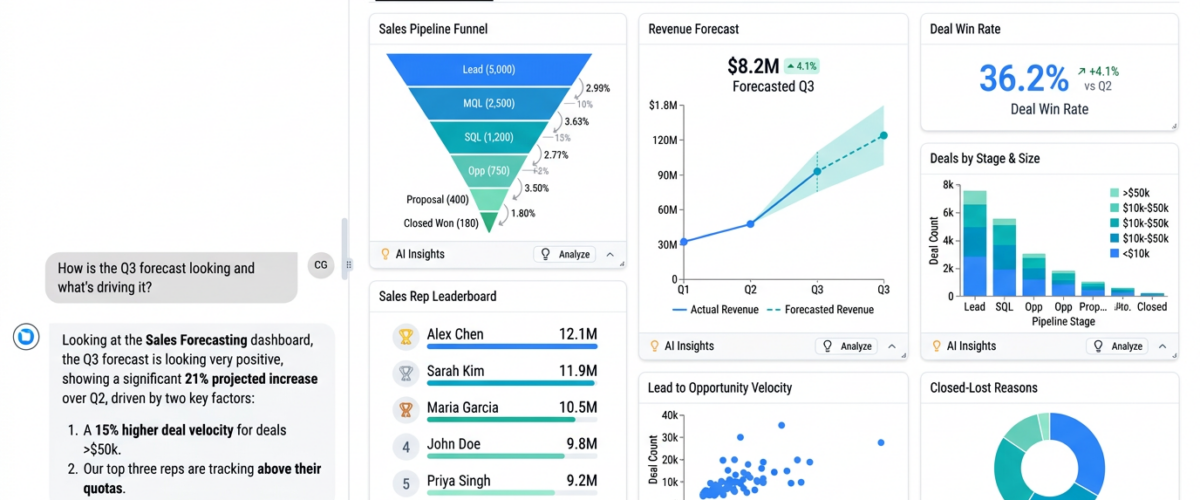
AI dashboards like Pulse AI visualize your pipeline with intelligence built in. Instead of a static funnel chart, you get a dynamic view that shows pipeline velocity (how fast deals move through stages), stage-specific conversion rates, pipeline coverage ratio (do you have enough pipeline to hit quota?), and predicted revenue by close date.
The AI also flags pipeline health issues: “Your discovery-to-proposal conversion rate dropped from 45% to 28% this month. The primary factor is a 3x increase in deals with no follow-up meeting scheduled within 7 days of discovery.”
3. Revenue Forecasting
Traditional forecasting relies on sales rep judgment — notoriously optimistic. AI forecasting models use objective data: historical close rates by stage, deal characteristics, time in stage, activity patterns, and external factors. The result is a probabilistic forecast with confidence intervals: “Most likely Q2 revenue: $782K (60% confidence range: $650K-$910K).”
This lets leadership plan with realistic expectations rather than hoping the team’s optimism translates to reality.
4. Activity-Outcome Analysis
AI connects sales activities to outcomes at a granular level. It can tell you: the optimal number of touchpoints before a proposal, which email templates have the highest response rates, the best time windows for outreach by industry segment, and which combination of activities most strongly predicts a closed deal.
Building a Sales Analytics Dashboard
An effective AI sales dashboard should answer these questions at a glance:
Are we on track to hit target? Show predicted revenue vs. quota with a confidence range. Make it the first thing your VP of Sales sees every morning.
Where are the risks? Highlight deals that have stalled, slipped stages, or have deteriorating engagement scores. AI should flag these automatically, not require manual review.
What should reps do today? AI-generated priority lists showing which deals need attention, what type of action is recommended, and why. “Contact [Deal A] — champion hasn’t engaged in 8 days, which historically correlates with 45% deal loss probability.”
How is each rep performing? Not just quota attainment, but activity quality metrics: meetings per deal, email response rates, pipeline velocity, and win rate by deal size.
Real Impact: What Sales Teams See After Implementing AI Analytics
Forecast accuracy improves 25-40%. When AI models replace gut-feel forecasting, the gap between predicted and actual revenue narrows dramatically. This enables better resource planning, hiring decisions, and financial projections.
Win rates increase 10-20%. When reps focus on high-probability deals and follow AI-recommended engagement patterns, conversion rates improve. The AI helps them prioritize — not work harder, but work smarter.
Sales cycle length decreases. AI identifies where deals typically stall and recommends actions to keep momentum. Teams that follow AI-guided next-best-action recommendations see 15-25% shorter sales cycles.
Frequently Asked Questions
Does AI sales analytics replace the CRM?
No — it sits on top of your CRM. Your CRM (Salesforce, HubSpot, Pipedrive) remains the system of record for deal data. AI analytics platforms connect to your CRM, analyze the data, and deliver insights back. Think of AI analytics as making your CRM data actually useful.
How much historical data do I need for accurate predictions?
Most AI models need 6-12 months of deal history with at least 100 closed deals (won and lost) to build reliable predictions. More data improves accuracy, but even modest datasets can provide useful directional insights.
Will my sales reps actually use AI analytics?
If the insights are accurate and actionable, yes. The key is delivering AI insights where reps already work (inside the CRM, via Slack/email alerts, on mobile) rather than requiring them to log into a separate dashboard. Start with one high-value insight — like deal risk alerts — and let adoption grow from there.