The Data Bottleneck Problem
In most organizations, data access looks like this: a marketing manager has a question about campaign performance. They email the analytics team. The analytics team adds it to their queue. Three days later, the analyst builds a report. The marketing manager reviews it, realizes they need a slightly different cut of the data, and sends another request. Another two days. By the time the answer arrives, the campaign has already run its course.
This bottleneck isn’t the analytics team’s fault — they’re simply overwhelmed. According to Gartner, the average analytics team has a backlog of 3-6 weeks of pending requests. That means most data questions either wait too long to be actionable or never get asked at all.
Data democratization solves this by giving every team member — regardless of technical skill — the ability to access and analyze data independently. And AI is what makes this practical.
Why Previous Attempts at Data Democratization Failed
This isn’t a new idea. Companies have been trying to make data accessible for years with self-service BI tools. Most attempts fell short because the tools still required significant training: you needed to understand data models, write formulas, configure chart parameters, and know which tables and fields contained the data you needed.
Giving a marketing manager access to Tableau doesn’t democratize data — it just moves the bottleneck from the analytics team to the individual, who now spends hours struggling with a tool they weren’t trained on.
AI changes the equation entirely. When you can ask a question in plain English and get an instant, accurate visualization, the technical barrier disappears.
How AI Enables True Data Democratization
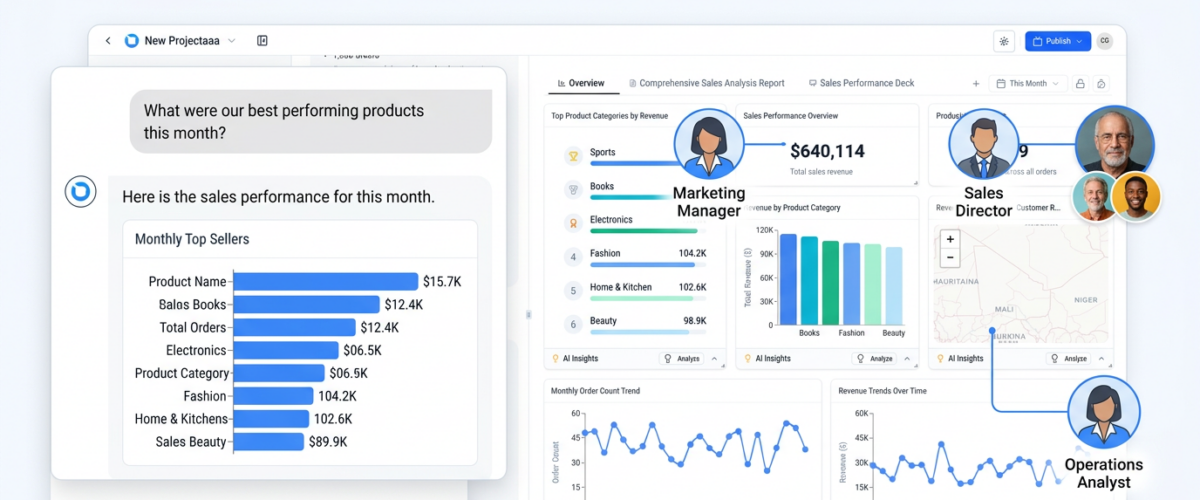
Natural language querying eliminates the skills gap. Platforms like Pulse AI let anyone ask questions like “What were our top 10 customers by revenue last quarter?” or “How does this month’s churn compare to the same month last year?” The AI translates these into data queries, selects the appropriate visualization, and delivers the answer in seconds.
AI handles the technical complexity invisibly. Behind the scenes, the AI knows which database tables to query, how to join data across sources, which aggregations to apply, and which chart type to use. The user doesn’t need to know any of this — they just ask their question.
Contextual follow-ups enable deeper exploration. Data democratization isn’t just about getting a chart — it’s about enabling exploration. AI maintains conversational context so users can naturally drill deeper: “Show me revenue by region” → “Which region grew fastest?” → “What products are driving growth in that region?” Each follow-up builds on the previous answer.
AI guardrails prevent misinterpretation. One concern with data democratization is that non-experts might misinterpret data. AI helps here too — it can add context to visualizations (“Note: this comparison covers different time periods”), flag statistically insignificant differences, and suggest more appropriate analyses when a user’s question might lead to misleading conclusions.
Who Benefits from Data Democratization?
Marketing teams can check campaign performance, compare channels, and analyze customer segments without waiting for analytics support. They become more agile and data-driven in their decision-making.
Sales managers can pull their own pipeline reports, forecast revenue, and analyze win/loss patterns. They spend less time in spreadsheets and more time coaching reps.
Operations teams can monitor supply chain metrics, track fulfillment performance, and identify efficiency bottlenecks in real time.
Customer success teams can analyze usage patterns, identify at-risk accounts, and measure the impact of their interventions — all without a single SQL query.
Executives can get real-time answers during meetings instead of saying “let me get the analytics team to pull that.” This dramatically improves decision speed at the leadership level.
Implementing Data Democratization Successfully
Start with champions, not mandates. Find 2-3 team members across different departments who are naturally curious about data. Get them set up with the AI analytics platform first. Their enthusiasm and results will create organic demand.
Define a data glossary. Ensure everyone means the same thing when they say “revenue” or “active customer.” AI platforms work best when business terms are clearly defined and mapped to data fields. Most platforms support custom glossaries that help the NLQ engine interpret business-specific terminology.
Maintain governance without gatekeeping. Democratization doesn’t mean chaos. Set up role-based access so people see data relevant to their function. The goal is “everyone can access what they need” not “everyone can see everything.”
Celebrate data-driven decisions. When a team member uses the AI dashboard to discover an insight that improves a business outcome, share that story. This builds a data culture from the bottom up.
Frequently Asked Questions
Won’t data democratization overwhelm our database with queries?
Modern AI BI platforms use caching, query optimization, and read replicas to handle increased query volume without impacting production systems. The AI also consolidates similar queries rather than running redundant database calls.
How do we prevent people from drawing wrong conclusions?
AI helps by adding context, flagging small sample sizes, noting confounding variables, and suggesting more appropriate analyses. Additionally, providing basic data literacy training alongside tool access ensures users can think critically about what they see.
What if our data is messy or incomplete?
Data democratization actually helps surface data quality issues faster. When more people access data, problems get spotted and reported more quickly. Most AI BI platforms also include data profiling features that automatically identify quality issues.