The Attribution Black Box
You spent $2,000 on Google Ads last month, $1,500 on Facebook, and invested time in SEO and email campaigns. Your revenue was up, but you have no idea which channel deserves the credit. Google Ads says they drove 50 conversions. Facebook claims 35. Your analytics shows most sales came from “direct” traffic. None of this helps you decide where to invest next month.
Marketing attribution — figuring out which channels actually drive revenue — is one of the hardest problems in business analytics. But it’s also one of the most valuable to solve. Here’s how to do it without hiring a data scientist.
Marketing Attribution Models Explained Simply
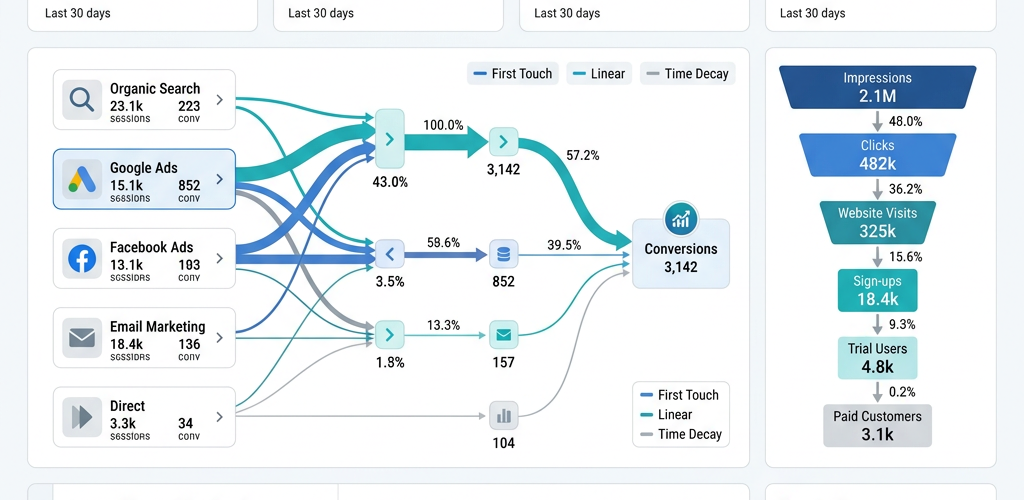
Attribution is the process of giving credit to marketing channels for sales. The problem: customers rarely see one ad and immediately buy. They might click a Facebook ad, Google your brand name later, read an email, and then purchase. Which channel “caused” that sale?
Last-click attribution gives all credit to the final touchpoint before purchase. If someone Googled your brand name and then bought, organic search gets 100% credit — even if they discovered you from a Facebook ad weeks ago. This is simple but deeply flawed. It overvalues bottom-of-funnel channels (branded search, direct traffic) and undervalues top-of-funnel discovery channels (social ads, content).
First-click attribution gives all credit to the first touchpoint. Whoever introduced the customer to your brand gets 100% credit. This overvalues awareness channels and ignores the nurturing that happens afterward.
Linear attribution splits credit evenly across all touchpoints. If a customer had 4 interactions before buying, each gets 25% credit. Fair but unsophisticated — not all touchpoints contribute equally.
Time-decay attribution gives more credit to recent touchpoints. The logic: interactions closer to the purchase probably mattered more. Common in B2B with long sales cycles.
Data-driven attribution uses machine learning to analyze thousands of customer journeys and determine which touchpoints statistically lead to conversions. This is the gold standard but requires significant data volume (thousands of conversions per month) to work accurately. Tools like Pulse AI can implement basic data-driven attribution even for smaller businesses by analyzing patterns across your full customer dataset.
How to Track ROI by Marketing Channel Without a Data Team
You don’t need perfect attribution to make better marketing decisions. You need directional accuracy — good enough to know which channels are working and which aren’t. Here’s the practical approach:
Step 1: Implement UTM tracking on everything. Every link in every marketing campaign should have UTM parameters (source, medium, campaign). This is non-negotiable. Without UTMs, you’re flying blind. Facebook ad? utm_source=facebook&utm_medium=cpc&utm_campaign=spring_sale. Email newsletter? utm_source=newsletter&utm_medium=email&utm_campaign=march_2026. This is how analytics platforms know where traffic came from.
Step 2: Connect your ad platforms and analytics to one dashboard. You need to see spend (from ad platforms) and revenue (from your e-commerce/CRM) in the same place. Pulse AI, for example, pulls from Google Ads, Facebook Ads, your e-commerce platform, and analytics simultaneously — so you can see $2,000 Facebook spend next to the revenue attributed to Facebook traffic.
Step 3: Calculate cost per acquisition (CPA) by channel. Total spend divided by conversions from that channel. If you spent $2,000 on Google Ads and got 40 purchases, your CPA is $50. Do this for every channel. The channels with the lowest CPA (where you’re paying the least to acquire a customer) are your most efficient.
Step 4: Factor in customer lifetime value (LTV). A $50 CPA is great if those customers spend $200 on average. It’s terrible if they spend $30. Segment your attribution by channel to understand not just acquisition cost but customer quality. Some channels bring one-time buyers; others bring repeat customers.
Step 5: Run incrementality tests. The ultimate attribution test: turn a channel off and see what happens. If you pause Facebook ads for 2 weeks and revenue drops, Facebook was driving real incremental sales. If revenue stays flat, those “Facebook conversions” were probably people who would have found you anyway. This is the only way to measure true causality.
Multi-Touch Attribution for Small Businesses: What’s Actually Feasible
Full multi-touch attribution used to require enterprise analytics stacks and six-figure budgets. In 2026, it’s accessible to small businesses — but you need to understand what’s realistic with limited data.
If you have under 100 conversions per month: Stick with last-click or first-click attribution. Multi-touch models need volume to be statistically meaningful. Focus on UTM consistency and basic channel-level ROI tracking. AI tools can still provide value by aggregating your data and surfacing patterns, even with limited volume.
If you have 100-500 conversions per month: You can start using time-decay or position-based attribution models. These give you better insight into the full customer journey without requiring the massive data volumes that data-driven models need. Connect your platforms to a tool that can track the multi-touch journey automatically.
If you have 500+ conversions per month: Data-driven attribution becomes viable. AI can analyze your conversion paths and determine which touchpoint combinations lead to sales. This is where platforms like Pulse AI use machine learning to tell you “customers who see a Facebook ad, then an email, then a Google search convert at 3x the rate of single-touch journeys.”
The Assisted Conversions Metric You’re Probably Ignoring
Last-click attribution tells you which channel closed the deal. But what about the channels that assisted? Google Analytics has an “Assisted Conversions” report that most people never look at — and it’s one of the most valuable.
An assisted conversion is when a channel appeared in the customer journey but wasn’t the final click. For example: a customer clicks your Facebook ad (assisted), then Googles your brand name a week later and purchases (last click). Last-click gives Google 100% credit, but Facebook introduced the customer.
Calculate the assisted conversion rate for each channel: (Assisted conversions + Last-click conversions) / Last-click conversions. A high ratio means that channel is an important discovery mechanism even if it doesn’t close sales directly. Content marketing and social media often have high assisted conversion rates — they’re introducing people to your brand, even if direct/search closes the sale.
If you cut a channel with a high assisted conversion rate because it has a “bad” last-click ROI, you’ll see your direct and branded search traffic drop weeks later. That channel was feeding your pipeline.
Frequently Asked Questions
Why does every platform claim credit for the same sale?
Because they’re using different attribution models. Google Ads might use last-click within their platform. Facebook might use a 7-day click + 1-day view window. Your analytics might use first-click. Each platform is technically correct within its own rules — they’re just playing different games. This is why you need a neutral platform that pulls data from all sources and applies consistent attribution logic.
What’s the best attribution model for e-commerce businesses?
For most e-commerce companies with short sales cycles (purchase within 7 days of first visit), time-decay attribution or data-driven attribution work best. They give appropriate credit to discovery channels while still valuing the final conversion touchpoint. Avoid pure last-click — it will systematically undervalue your top-of-funnel marketing.
How do I attribute sales from repeat customers?
This is tricky because repeat customers already know your brand. Most attribution models only track the journey for the specific purchase, not the relationship history. A more sophisticated approach: attribute the first purchase to the original acquisition channel, then treat repeat purchases separately as retention metrics. If someone bought once via Google Ads, their repeat purchases 3 months later shouldn’t be credited to that original ad — they’re a retention/email success.
Can AI solve attribution automatically?
AI can significantly improve attribution by analyzing patterns across thousands of customer journeys and identifying which combinations of touchpoints lead to conversions. Tools like Pulse AI use machine learning to go beyond simple rules-based attribution (first click, last click) and actually model the incremental value of each channel. But AI still needs clean data — if your UTM tracking is inconsistent or you’re not connecting all your data sources, even the smartest AI can’t fix it.