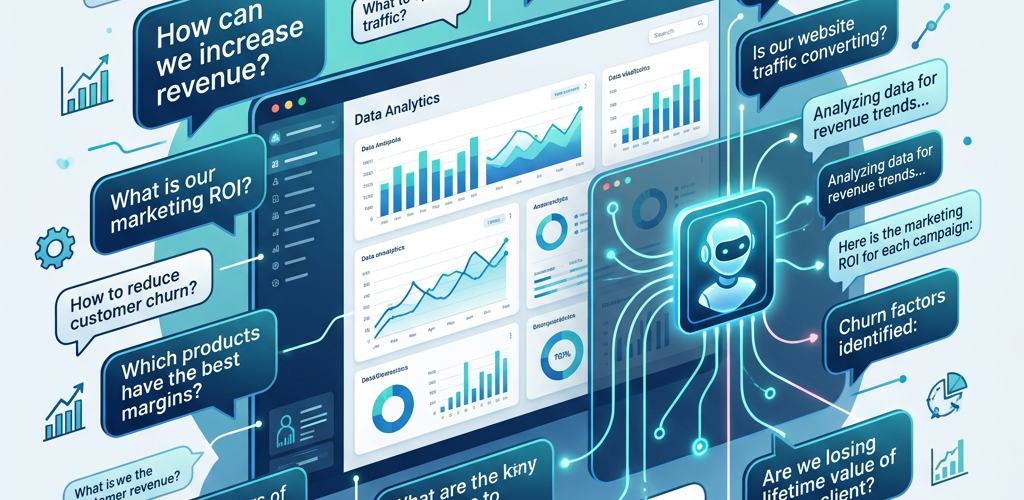
You’ve connected your data to an analytics tool. Now you’re staring at a blank query box thinking… what do I actually ask? This is the most common blocker for businesses new to AI analytics. You know your data has answers — you just don’t know the right questions.
Here are 50+ specific, tested questions you can ask your business data right now. These work with any AI analytics tool that supports natural language queries — just type them in and get instant answers.
Revenue and Sales Questions
Start here. Revenue questions give you the clearest picture of business health and are the easiest to act on.
“What were my total sales this month compared to last month?” — The most fundamental question. Shows you the direction your business is heading.
“Which products generate the most revenue?” — Identifies your winners. Often, 20% of products drive 80% of revenue (Pareto principle).
“What is my average order value, and how has it changed over the past 6 months?” — Rising AOV means your upselling is working. Falling AOV needs investigation.
“What day of the week and time of day do I get the most sales?” — Critical for timing promotions, email sends, and social media posts.
“Which sales channel (online, in-store, marketplace) is growing fastest?” — Tells you where to double down on investment.
“What is my monthly recurring revenue trend?” — For subscription businesses, this is the single most important metric.
“How many new customers did I acquire this month vs. repeat customers?” — Balance between acquisition and retention spending.
“What is my customer lifetime value by acquisition channel?” — Some channels bring cheap customers who never return. Others bring expensive customers who become loyal. This question reveals which is which.
Marketing and Customer Acquisition Questions
These questions help you stop wasting money on marketing that doesn’t work and double down on what does.
“Which marketing channel has the lowest customer acquisition cost?” — Stop guessing where to spend your marketing budget.
“What is my conversion rate by traffic source?” — High traffic with low conversion means the wrong audience. Low traffic with high conversion means an untapped goldmine.
“How has my website traffic changed over the past 3 months, and where is the growth coming from?” — Identifies which channels are gaining momentum.
“What is the ROI on my paid advertising spend by platform?” — Direct answer to “is my Google/Meta/TikTok ad spend profitable?”
“Which blog posts or landing pages drive the most conversions?” — Create more content like your winners.
“What is my email open rate and click-through rate trend?” — Declining email engagement is an early warning sign.
“How long does it take a new lead to become a paying customer?” — Your sales cycle length directly impacts cash flow planning.
Financial Health Questions
These questions keep you solvent and help you spot financial problems before they become crises.
“What is my gross profit margin by product or service?” — Not all revenue is equal. Some products might be revenue-positive but margin-negative.
“What are my top 5 expense categories, and how have they changed?” — Spending creep is real. This question catches it early.
“What is my burn rate at current spending levels?” — For startups: how many months of runway do you have?
“What is my accounts receivable aging?” — Which customers owe you money, and how long have they owed it?
“What is my cash flow forecast for the next 3 months based on current trends?” — Predictive analytics at its most practical.
“What percentage of my revenue comes from my top 10 customers?” — High concentration = high risk. If one big customer leaves, can you survive?
Customer Behavior Questions
Understanding how customers behave helps you keep them longer and increase their spending.
“What is my customer churn rate, and is it increasing or decreasing?” — If churn is rising, no amount of new customer acquisition will save you.
“What do customers buy together most frequently?” — Informs product bundling, cross-sell recommendations, and store layout.
“What is the average time between a customer’s first and second purchase?” — This is your critical retention window. If they don’t buy again within this period, they probably never will.
“Which customers are at risk of churning?” — AI can identify customers whose behavior patterns match those who have already left. Reach out before they’re gone.
“What is my Net Promoter Score trend?” — If you collect NPS data, tracking the trend is more valuable than any single score.
“Which customer segments are most profitable?” — Demographics, geography, acquisition channel, product preferences — slice your customer base to find your best segments.
Operations and Efficiency Questions
These questions help you run a tighter ship and identify operational waste.
“What is my inventory turnover rate by product?” — Slow-moving inventory ties up cash. Fast movers might need more stock.
“What is my order fulfillment time, and has it changed?” — Increasing fulfillment time means scaling problems.
“What is my customer support ticket volume trend, and what are the most common issues?” — Rising support volume might indicate a product problem. The most common issues tell you what to fix first.
“What is my employee productivity by team or department?” — Revenue per employee, tickets resolved per agent, units produced per shift — depends on your business.
“What is my on-time delivery rate?” — Late deliveries kill customer satisfaction and drive churn.
Strategic and Forward-Looking Questions
These questions help you plan for the future, not just understand the past.
“Based on current trends, what will my revenue be in 6 months?” — AI-powered forecasting gives you a data-driven answer.
“Which product categories show the strongest growth trajectory?” — Invest where momentum is building.
“If I increase my marketing spend by 20%, what’s the projected revenue impact?” — Scenario modeling to test decisions before making them.
“What external factors (seasonality, economic indicators) correlate with my sales?” — Understanding external drivers helps you plan around them.
How to Get Started
Don’t try to ask all 50 questions at once. Start with the top 3-5 most relevant to your current situation:
If you’re focused on growth: Start with revenue trends, customer acquisition cost, and marketing ROI questions.
If you’re focused on profitability: Start with margins, expense tracking, and customer lifetime value questions.
If you’re focused on retention: Start with churn rate, repeat purchase behavior, and customer satisfaction questions.
Tools like Pulse AI let you type any of these questions directly and get an instant, visual answer. The AI understands business context — you don’t need to translate your question into technical terms.
Frequently Asked Questions
Do I need all my data connected to start asking questions?
No. Start with whatever data you have. Even connecting just your sales platform gives you valuable insights about revenue trends, product performance, and customer behavior. You can add more data sources over time.
How specific should my questions be?
The more specific, the more actionable the answer. “How are sales?” gives you a general trend. “What were sales of Product X in the Northeast region for customers acquired through paid search in the last 90 days?” gives you a precise answer you can act on immediately.
What if the AI gives me an answer that doesn’t look right?
AI analytics is only as good as your data. If an answer seems wrong, check the underlying data for gaps, duplicates, or errors. Most tools let you drill down into the raw data behind any insight to verify accuracy.