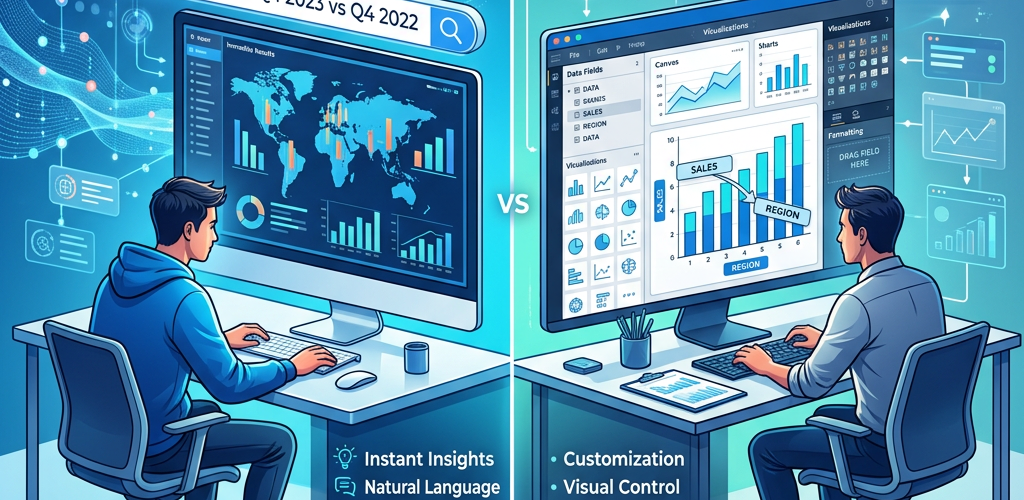
ThoughtSpot and Tableau represent two fundamentally different philosophies in business intelligence. Tableau is the visualization powerhouse — drag-and-drop report building for analysts who want total control over every chart. ThoughtSpot is the search-driven platform — type a question, get an answer, no report building required. Choosing between them depends on who will use the tool, how technical your team is, and whether you need to build dashboards or just get answers.
The quick take: Tableau wins for teams with dedicated analysts who need advanced visualizations, complex calculations, and pixel-perfect reports. ThoughtSpot wins for organizations that want self-service analytics where business users can ask questions without waiting for an analyst to build a report. Pulse AI offers a similar natural-language approach to ThoughtSpot but at a fraction of the cost, without requiring a data warehouse — more on that below.
Pricing: Where the Sticker Shock Lives
Tableau: Transparent, accessible pricing. Creator licenses ($70/month) for analysts who build reports. Viewer licenses ($15/month) for stakeholders who just consume dashboards. You can start small and scale.
ThoughtSpot: Custom pricing only — no public rates. Industry estimates put it around $100,000-300,000/year for mid-size deployments. The pricing model is designed for large enterprises (500+ employees), not startups or SMBs.
Winner: Tableau for transparency and accessibility. ThoughtSpot’s pricing gates out smaller teams entirely.
Data Connectivity: The Make-or-Break Issue
Tableau: Connects to almost anything — spreadsheets, databases, cloud services, APIs, flat files. Can work with data as-is (live connections) or import it into Tableau’s in-memory engine (extracts). Very flexible about data sources.
ThoughtSpot: Requires a cloud data warehouse. You need your data in Snowflake, BigQuery, Redshift, Databricks, or Azure Synapse before ThoughtSpot can work with it. No CSV uploads, no spreadsheet connections, no direct SaaS tool integrations. The data warehouse requirement is a hard gate.
Winner: Tableau, by a lot. ThoughtSpot’s data warehouse requirement adds cost and complexity that many organizations aren’t ready for.
User Experience: Who Can Actually Use These Tools?
Tableau: Drag-and-drop interface for building charts. Powerful but requires training — most users need 1-2 weeks to build basic dashboards confidently. Non-technical users can view dashboards and apply filters easily, but they can’t create new visuals without help.
ThoughtSpot: Natural language search interface. Users type questions (“revenue by product last quarter”) and get instant answers. Zero training required for end users. But backend setup (data modeling, TML, worksheet design) is complex and requires database expertise.
Winner: Depends on your team. ThoughtSpot wins for end-user simplicity. Tableau wins for analyst power and control.
When to Choose Tableau
Your team has dedicated analysts who build reports for the organization. They want control over every visual element and the power to create complex calculations.
Visualization quality matters. Board presentations, client reports, public-facing dashboards — Tableau produces the most polished output.
Your data lives in diverse sources. Spreadsheets, databases, cloud apps, flat files — Tableau connects to all of them without requiring a data warehouse.
Budget is a concern. Tableau’s per-user pricing is transparent and accessible. You can start with one Creator license and scale up.
When to Choose ThoughtSpot
Business users need to ask ad-hoc questions without submitting requests to a data team. Your analysts are drowning in “can you pull this for me” requests.
You already have a cloud data warehouse. If your data is in Snowflake or BigQuery, ThoughtSpot’s connection is seamless. If not, the cost and effort of building a warehouse just for ThoughtSpot is hard to justify.
Speed of answer matters more than chart beauty. If the goal is quick answers — not beautifully formatted reports — ThoughtSpot delivers.
Your organization is large enough to justify the investment. ThoughtSpot’s pricing makes most sense at 50+ users where the per-user cost of analyst bottlenecks outweighs the platform cost.
The Third Option: AI Analytics Without the Infrastructure
Both Tableau and ThoughtSpot require significant investment — either in analyst time (Tableau) or data warehouse infrastructure (ThoughtSpot). There’s a growing category of AI-native analytics tools that eliminate both requirements.
These tools connect directly to your existing data sources (SaaS tools, databases, spreadsheets), let you ask questions in plain English, and generate answers automatically — no dashboard building, no data warehouse, no data modeling.
For teams that want the self-service promise of ThoughtSpot without the data warehouse requirement, or the analytical power of Tableau without the learning curve, AI-native tools are worth evaluating.
FAQ
Can ThoughtSpot replace Tableau?
For ad-hoc questions and self-service analytics, yes. For polished reports, executive dashboards, and complex visualizations, no. Many organizations use both — Tableau for formal reporting, ThoughtSpot for self-service exploration.
Is ThoughtSpot easier than Tableau?
For end users asking questions, yes — significantly easier. For administrators setting up the platform, no — ThoughtSpot’s backend configuration (data modeling, TML, worksheet design) is complex and requires database expertise.
Do I need a data warehouse for ThoughtSpot?
Yes. ThoughtSpot requires Snowflake, BigQuery, Redshift, Databricks, or Azure Synapse. There’s no way around this requirement. If you don’t have a data warehouse, factor $500-5,000+/month in additional infrastructure costs.
What about Tableau Pulse and natural language?
Tableau is investing heavily in AI features through Tableau Pulse (automated insights) and improved Ask Data. These are getting better but are still add-on features, not the core experience. ThoughtSpot’s natural language is more mature today.
Which has better ROI?
Depends on your bottleneck. If analysts spend 60% of their time building reports for others, ThoughtSpot has faster ROI by eliminating that bottleneck. If your challenge is making sense of complex data through visualization, Tableau’s ROI comes from better analysis quality.