From Asking Questions to Getting Answers You Didn’t Know to Ask
Traditional business intelligence tools wait for you to ask questions. You build a query, create a dashboard, set up a report. The tool responds — but only to what you explicitly ask for. Agentic AI changes this paradigm entirely. Instead of waiting for instructions, agentic AI systems proactively analyze your data, identify patterns and anomalies, generate hypotheses, and deliver insights you didn’t know you needed.
The term “agentic AI” refers to AI systems that can act autonomously toward goals, not just respond to prompts. In business intelligence, this means an AI that doesn’t just visualize your data — it continuously monitors it, understands your business context, and takes initiative to surface the insights that matter most.
How Agentic AI Differs from Traditional AI in BI
Traditional BI (Pre-AI): You write SQL queries, build reports, schedule them to run weekly. You get the answers to questions you already know to ask.
AI-Assisted BI (Current): You ask questions in natural language — “Show me revenue by region for Q3” — and the AI generates the visualization. Faster and easier, but still reactive. You still need to know what to ask.
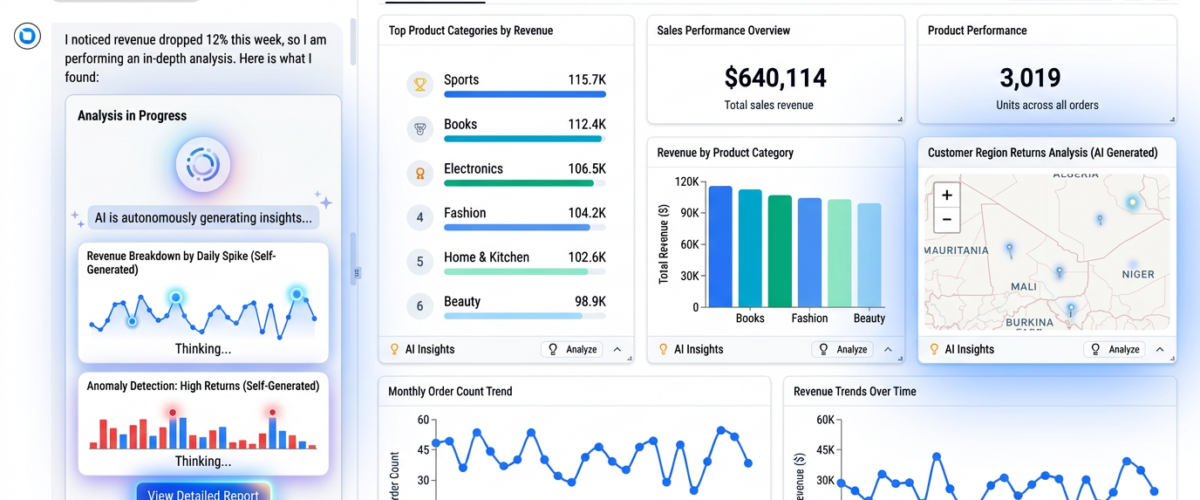
Agentic AI BI (Emerging): The AI agent monitors your data continuously. It notices that revenue in the Southeast region dropped 15% last Tuesday. It investigates automatically: checks if it’s seasonal, compares it to marketing spend changes, looks at competitor activity signals. Then it sends you a brief: “Southeast revenue dropped 15% starting March 5. Root cause analysis suggests the new shipping cost increase (implemented March 4) is the primary driver. Recommendation: A/B test free shipping threshold in the Southeast region.”
The difference is profound. You went from “build me a chart” to having a data analyst that never sleeps, never forgets to check something, and surfaces insights in real time.
What Agentic AI Can Do in Practice
Autonomous anomaly detection and root cause analysis. When metrics deviate from expected patterns, agentic AI doesn’t just flag the anomaly — it investigates. It cross-references related metrics, checks for correlated events (deployments, campaigns, market changes), and delivers a root cause hypothesis with supporting evidence.
Proactive opportunity identification. Beyond finding problems, agentic AI spots opportunities. It might notice that customers who use feature X have 40% higher retention and suggest expanding feature X promotion to under-utilizing segments.
Automated report generation and distribution. Instead of scheduled reports, agentic AI generates reports when there’s something worth reporting. Monday was uneventful? No report. Wednesday showed a significant shift in customer behavior? You get a detailed analysis within hours.
Natural language interaction with follow-up capability. Platforms like Pulse AI enable conversational analytics where you can ask follow-up questions naturally. Ask “Why did churn increase?” and then follow up with “Which customer segment is most affected?” — the AI maintains context across the conversation.
The Technology Behind Agentic AI in BI
Agentic AI in business intelligence combines several technologies:
Large Language Models (LLMs) enable natural language understanding and generation. They translate your questions into data queries and data results into human-readable insights.
Continuous monitoring agents run in the background, analyzing data streams for statistically significant changes. These aren’t simple threshold alerts — they use statistical models to distinguish real anomalies from normal variance.
Reasoning chains allow the AI to perform multi-step analysis. When it detects an anomaly, it can plan and execute a sequence of analytical steps to investigate the cause — similar to how a human analyst would work, but faster and more thorough.
Action frameworks enable the AI to take action beyond just reporting. This might mean sending an alert to the right person, updating a dashboard, creating a new visualization, or even triggering a workflow in another system.
Is Agentic AI Ready for Production?
The honest answer: it’s emerging. Some capabilities — like natural language querying, automated visualization, and basic anomaly detection — are production-ready today. More advanced agentic behaviors — like autonomous root cause analysis and proactive recommendations — are available in leading platforms but require careful configuration and validation.
The key is starting now. Companies that begin building their AI analytics infrastructure today will be best positioned to leverage increasingly agentic capabilities as the technology matures. The foundation is the same: clean data, proper integrations, and a culture that trusts data-driven insights.
Frequently Asked Questions
Is agentic AI the same as AutoML?
No. AutoML automates the process of building machine learning models. Agentic AI in BI is about autonomous data analysis and insight delivery. They can complement each other — an agentic BI system might use AutoML internally to build predictive models — but they’re different concepts.
Can agentic AI make business decisions autonomously?
Currently, agentic AI in BI focuses on analysis and recommendations, not autonomous decision-making. It might say “I recommend reducing ad spend on Channel X because ROI has dropped below threshold” but won’t actually change the ad budget. Human approval remains in the loop for consequential decisions.
What data infrastructure do I need for agentic AI?
You need reliable data pipelines from your key business systems, a centralized data warehouse or lake, and an AI BI platform that supports agentic features. The good news is that modern platforms like Pulse AI handle much of this complexity — you connect your data sources and the AI takes it from there.